
The history of Volvo is unlike that of any other automobile manufacturer. While other brands built their legacies on speed, racing victories, or ostentatious luxury, Volvo built its reputation on a far more noble and fundamental principle: the sanctity of human life. Born in the harsh, unforgiving climate of Sweden, Volvo recognized early on that a car must be, above all else, a sanctuary. Their relentless dedication to safety innovation has not only defined their brand identity but has literally saved millions of lives across the globe, fundamentally shaping the modern automotive landscape.
Swedish Steel and Cold Beginnings
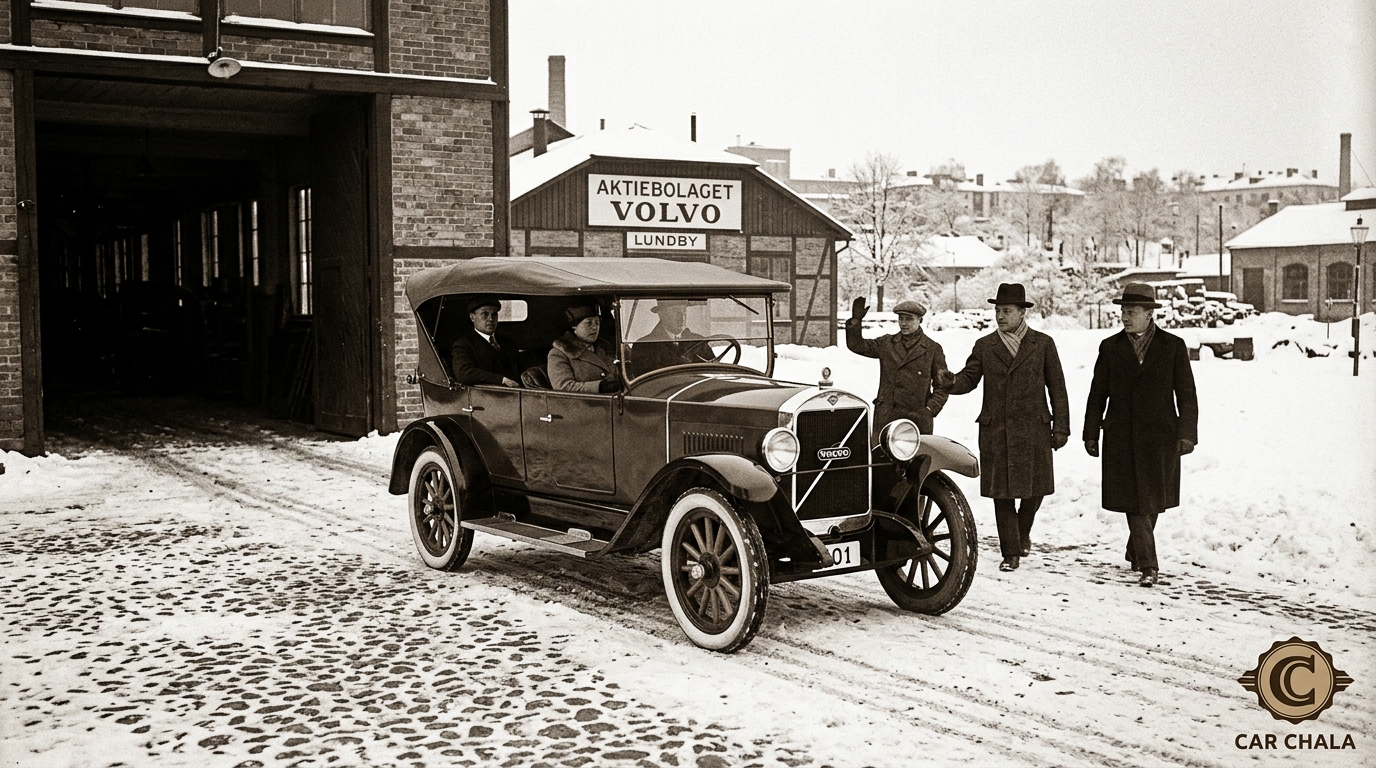
Volvo was founded in Gothenburg, Sweden, in 1927 by Assar Gabrielsson, an economist, and Gustav Larson, an engineer. The word "Volvo" is Latin for "I roll," originally intended as a name for a ball bearing company (SKF, which was the financial backer for the early auto venture).
Gabrielsson and Larson observed that the imported cars available in Sweden simply could not withstand the country's brutal winters, terrible road conditions, and freezing temperatures. They set out to build cars specifically designed to endure this harsh environment. Their guiding philosophy was clear from the very beginning.
"Cars are driven by people. The guiding principle behind everything we make at Volvo, therefore, is and must remain, safety."
The first Volvo car, the ÖV 4 (nicknamed "Jakob"), rolled off the assembly line in April 1927. Built with robust Swedish steel and designed for durability, it laid the foundation for the company's reputation for building solid, reliable machines. Over the following decades, Volvo expanded its lineup, producing sturdy sedans and reliable trucks that became essential to Swedish life and industry.
The Invention that Changed the World: The Three-Point Seatbelt
If Volvo had only contributed one innovation to the world, their place in history would still be permanently secured. In the 1950s, Volvo hired an aviation engineer named Nils Bohlin as their first chief safety engineer. Bohlin had previously worked on ejector seats for fighter jets, giving him a profound understanding of the immense forces exerted on the human body during sudden deceleration.
At the time, cars were equipped with primitive two-point lap belts, which often caused severe internal injuries in crashes. Bohlin set to work designing a superior solution. In 1959, Volvo introduced the three-point safety belt as standard equipment in the Amazon (120 Series) and PV544.
The genius of Bohlin's design was that it secured both the upper and lower body and was simple enough to fasten with one hand. It was a revolutionary breakthrough. But what Volvo did next is perhaps the greatest act of corporate altruism in industrial history: they left the patent open. They gave away the design for free, allowing any other car manufacturer to use it to protect their drivers. It is estimated that the three-point seatbelt has saved over one million lives globally since its invention.
The Jakob Rolls Out
Volvo is founded in Gothenburg, Sweden. The first car, the ÖV 4 (Jakob), is produced, designed specifically to withstand harsh Swedish roads and climate.
The Three-Point Seatbelt
Volvo engineer Nils Bohlin invents the three-point safety belt. Volvo standardizes it and generously opens the patent, allowing all manufacturers to use this life-saving technology.
Rear-Facing Child Seat
Inspired by how astronauts travel in space, Volvo tests the first rear-facing child safety seat, pioneering child passenger safety.
The Iconic 200 Series
Volvo launches the 200 Series (including the legendary 240). Its boxy design prioritizes safety crumple zones. It becomes an icon of durability and safety, selling over 2.8 million units.
SIPS is Introduced
Volvo introduces the Side Impact Protection System (SIPS) on the 850, revolutionizing structural integrity in side collisions.
The Ford Era
Volvo Cars is sold to the Ford Motor Company, joining Fords Premier Automotive Group alongside Jaguar and Aston Martin.
Acquisition by Geely
Zhejiang Geely Holding Group acquires Volvo from Ford. This provides Volvo with crucial investment capital while allowing them to maintain their Swedish identity and engineering autonomy.
The XC90 Rebirth
The launch of the second-generation XC90 marks a massive renaissance for Volvo, introducing a stunning new design language and advanced semi-autonomous safety features.
100% Electrified
Volvo achieves its goal of a completely electrified portfolio in India, assembling its luxury EVs like the EX30 and EX40 locally.
The EX90 Flagship
The ultra-safe, LiDAR-equipped flagship EX90 electric SUV is expected to hit Indian roads, redefining automotive safety in the EV era.
The Era of the Box: Form Following Function
Throughout the 1970s, 80s, and 90s, Volvo's dedication to safety heavily influenced their design language. To maximize internal space and, more importantly, to incorporate large, effective crumple zones, Volvo embraced rectilinear designs. The cars were distinctively, undeniably boxy.
The epitome of this era was the Volvo 240, launched in 1974. It wasn't sleek, it wasn't particularly fast, but it was virtually indestructible. The U.S. National Highway Traffic Safety Administration (NHTSA) even bought a fleet of Volvo 240s to establish the benchmark standards for crash testing.
These "flying bricks" became cultural icons. They were the vehicle of choice for safety-conscious families, university professors, and anyone who valued practicality and survival over flashiness. In motorsport, however, Volvo flipped the script. The turbocharged Volvo 850 Estate famously competed in the British Touring Car Championship in the 1990s, creating an unforgettable spectacle of a massive, boxy station wagon racing door-to-door with nimble sports sedans.
The Modern Renaissance and Scandinavian Luxury
At the turn of the millennium, Volvo faced challenges. It was acquired by Ford in 1999 and became part of the Premier Automotive Group. While this period saw the sharing of platforms, Volvo struggled to clearly define its place in the crowded premium market.
In 2010, everything changed. The Chinese automotive conglomerate Geely acquired Volvo from Ford. Many analysts were skeptical, fearing that Volvo would lose its Swedish soul. Instead, Geely did exactly what was needed: they provided massive financial backing and completely left the Swedes alone to design and engineer their cars in Gothenburg.
This ignited a spectacular renaissance. In 2015, Volvo launched the second-generation XC90. It was a revelation. It shed the old utilitarian image and introduced a stunning new design language characterized by the "Thor's Hammer" LED headlights and elegant, minimalist interiors crafted from open-pore wood, crystal glass, and fine leather. Volvo had discovered how to blend their unyielding commitment to safety with a uniquely calm, sophisticated, and distinctly Scandinavian interpretation of luxury.
Modern Volvo interiors are designed as a serene sanctuary, prioritizing calm, clean lines, sustainable materials, and intuitive technology over complex, cluttered displays.
Vision 2020 and the Electric Future
Volvo's commitment to safety has only intensified in the modern era. They introduced "Vision 2020," a profoundly bold corporate goal stating that no one should be killed or seriously injured in a new Volvo car. To achieve this, they pioneered advanced Active Safety technologies, including pedestrian and large animal detection, auto-braking systems (City Safety), and advanced lane-keeping aids. In 2020, they controversially limited the top speed of all their new cars to 180 km/h (112 mph), arguing that driving faster than that served no practical purpose and significantly increased the risk of severe injury.
Looking forward, Volvo is executing one of the most aggressive electrification strategies in the traditional automotive industry. They were the first major manufacturer to announce that every new car launched from 2019 onwards would have an electric motor (hybrid or fully electric). Now, they are committed to becoming a fully electric car company by 2030.
The launch of models like the EX90 flagship electric SUV represents the pinnacle of this strategy, featuring LiDAR sensors and incredibly advanced computing power to create a "safe space" around the vehicle, moving ever closer to fully autonomous driving.
From the freezing roads of Gothenburg to the forefront of global automotive safety and sustainability, Volvo's journey is a powerful testament to the value of having a clear, unwavering purpose. They proved that a car company could be deeply successful not by appealing to our desire for speed or status, but by fiercely protecting what matters most: human life. As they transition to a quiet, electric future, their legacy as the protectors of the road remains untouchable.