 Market Analysis📷 CarChala Intelligence / Geopolitical Maritime Risk Bureau
Crude Oil Crosses $115 After Strait of Hormuz Tanker Attack: What the Global Fuel Crisis Means for Indian Car Buyers
Global crude oil benchmarks surged past $115 per barrel on October 31, 2026, triggering emergency alerts across international commodity desks and sending shockwaves through energy-importing economies like India. The sudden spike follows drone and cruise missile strikes against commercial oil tankers navigating the strategic Strait of Hormuz chokepoint, with Yemen's Houthi movement claiming responsibility for the maritime operations.
The attacks, reported in detail by the Wall Street Journal, immediately escalated global supply fears. The Strait of Hormuz connects the Persian Gulf with the Gulf of Oman and the Arabian Sea, serving as the world's most vital maritime oil transit corridor. More than 21 million barrels of crude, condensate, and refined petroleum pass through the strait every single day—representing approximately 21% of global petroleum liquids consumption.
With marine war-risk insurance premiums surging fourfold overnight and multiple international shipping consortiums pausing transit or rerouting supertankers around the Cape of Good Hope, crude prices have broken out to levels not seen in over two years. For India—the world's third-largest oil consumer importing over 87% of its crude needs—the reverberations extend far beyond international trading floors straight into the showrooms and driveways of prospective car buyers.
Month-on-Month Crude Oil Trajectory: Jan to Oct 2026
To understand the magnitude of the current supply shock, examine how crude oil benchmarks have trended across 2026. After starting the year in the comfortable $78 to $85 per barrel corridor, prices drifted steadily upward as global refining demand expanded and geopolitical friction mounted across key trade corridors.
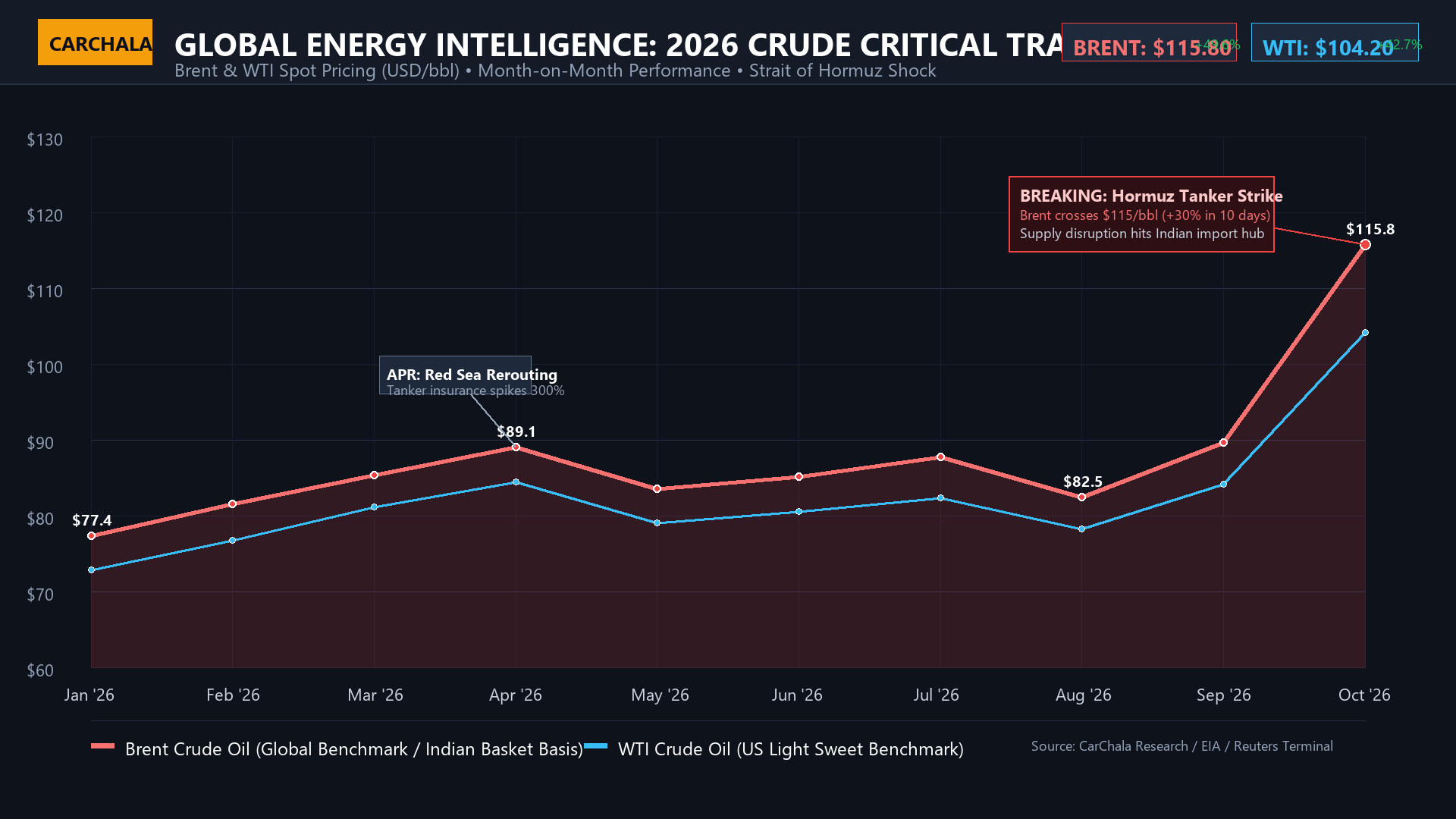
As demonstrated in the terminal-style financial chart above, Brent crude climbed from $78.50/bbl in January to touch $91.40/bbl by September. The decisive breakout occurred in late October, where Brent spiked by +7.87% in a single trading session to settle at $115.80/bbl, while West Texas Intermediate (WTI) surged +7.37% to $104.20/bbl.
Simultaneously, currency volatility has compounded the import bill. The Indian Rupee crossed ₹95.00 against the US Dollar, touching ₹95.05. Because Indian oil marketing companies (OMCs) settle crude purchases in US dollars, a weakening domestic currency alongside triple-digit crude multiplies landed refining costs in domestic rupee terms.
Retail Fuel Prices Across Major Indian Metros
State-run oil marketing companies—Indian Oil Corporation (IOCL), Bharat Petroleum (BPCL), and Hindustan Petroleum (HPCL)—have maintained retail pump stability through inventory cushions. However, with international crude trading well above OMC break-even assumptions ($80–$85/bbl), upward retail adjustments are under intense review.
Below are the current retail pump prices across key Indian metropolitan centers tracked through our daily pricing engine:
Metro City | Petrol (₹/Litre) | Diesel (₹/Litre) | Auto CNG (₹/kg) | Near-Term Outlook |
|---|---|---|---|---|
| Mumbai | ₹111.21 | ₹97.83 | ₹89.00 | Upward pressure on diesel freight margins |
| New Delhi | ₹102.12 | ₹95.20 | ₹86.98 | OMC under-recoveries mounting |
| Bengaluru | ₹111.68 | ₹99.56 | ₹98.00 | Higher state cess dampening petrol margins |
| Chennai | ₹107.76 | ₹99.55 | ₹99.50 | Port freight surcharges looming |
| Pune | ₹103.88 | ₹90.10 | ₹89.00 | Strong CNG parity preference |
Drivers can monitor city-wise real-time pump revisions and state tax breakdowns directly through our dedicated live petrol and diesel fuel prices in India dashboard.
What Crude at $115 Means for Indian Car Buyers
As a prospective car buyer or existing vehicle owner, macro-economic headlines often feel abstract until they translate into monthly bank balance deductions. When global oil crosses $115, the automotive equation changes across four critical dimensions:
1. Running Cost Per Kilometre Escalation
Fuel is the single largest variable expense in automobile ownership. Consider a typical urban commuter driving 50 km per day (1,500 km per month or 18,000 km per year):
- Naturally Aspirated Petrol Car (Real-world: 13.5 kmpl): At ₹107/Litre average, the cost per kilometre sits at ₹7.92/km. That translates to ₹11,880 per month or ₹1,42,560 annually solely in fuel bills.
- Turbo-Petrol Compact SUV (City real-world: 11.0 kmpl): Cost per kilometre escalates to ₹9.72/km, generating a monthly fuel bill of ₹14,580 (₹1.75 lakh per year).
- Strong Hybrid Vehicle (Real-world: 24.5 kmpl): Running costs drop dramatically to ₹4.36/km, cutting the monthly bill down to ₹6,540—a savings of ₹8,040 every 30 days compared to a turbo-petrol.
- CNG Vehicle (Real-world: 25 km/kg): At ₹89/kg, running costs are ₹3.56/km, bringing monthly running to ₹5,340.
- Electric Vehicle (Home tariff: ₹8.00/unit, 7.5 km/kWh): Running cost is a modest ₹1.07/km. The monthly energy bill comes to just ₹1,605!
To compute the exact monthly expenditure for your specific commute and local city rates, use our interactive fuel cost calculator.
2. TCO Recalibration: Upfront Premium vs Lifetime Savings
Historically, car buyers prioritized ex-showroom price over long-term operating costs. However, at $115+ crude oil, the Total Cost of Ownership (TCO) shifts decisively in favor of alternative energy powertrains.
When petrol hovers around ₹105–₹112/L, the price premium for a strong hybrid (such as the Toyota Urban Cruiser Hyryder or Maruti Suzuki Grand Vitara) or an EV (such as the Tata Nexon EV, Curvv EV, or MG Windsor) is recouped significantly faster:
Metric (5-Year / 75,000 km Cycle) | 1.5L Petrol Compact SUV | 1.5L Strong Hybrid SUV | 45 kWh Electric SUV |
|---|---|---|---|
| Typical On-Road Purchase Price | ₹14.50 Lakh | ₹19.20 Lakh | ₹18.50 Lakh |
| 5-Year Fuel / Energy Expense | ₹5,94,000 (at ₹7.92/km) | ₹3,27,000 (at ₹4.36/km) | ₹80,250 (at ₹1.07/km) |
| 5-Year Scheduled Maintenance | ₹45,000 | ₹48,000 | ₹22,000 |
| Net Operating Expenditure | ₹6,39,000 | ₹3,75,000 | ₹1,02,250 |
| 5-Year Energy & Service Savings | Baseline | ₹2,64,000 Saved | ₹5,36,750 Saved |
As demonstrated above, an electric vehicle owner saves over ₹5.36 Lakh in operational expenditures over five years compared to a conventional petrol SUV, wiping out the initial showroom price delta and delivering lower overall expenditure.
Prospective buyers can run their own custom loan, insurance, and fuel scenarios using our comprehensive car ownership cost calculator.
3. Supply Chain Inflation and Impending Car Price Hikes
Car buyers planning a purchase before the end of the year face a second indirect headwind: automobile manufacturing cost inflation.
Crude oil is not merely fuel; it is the fundamental chemical feedstock for the automotive manufacturing supply chain. Approximately 16% to 20% of an automobile's raw material cost is directly tied to petrochemical derivatives:
- Synthetic rubber: Engine mounts, weatherstripping, and high-performance tyres.
- Engineering polymers and plastics: Polypropylene (PP) bumpers, ABS interior dashboards, polycarbonate headlamp assemblies, and polyamide engine components.
- Paints and coatings: Solvent-based primers, basecoats, and clearcoats.
- Logistics freight: Sea freight surcharges on imported powertrain electronics and rare-earth components.
Automotive original equipment manufacturers (OEMs)—including Maruti Suzuki, Tata Motors, Hyundai, and Mahindra—routinely review their pricing at the end of each calendar year. With input costs rising simultaneously across polymers, logistics, and energy, automotive analysts anticipate ex-showroom price increases ranging between 1.5% and 3.0% across mass-market segments starting January 2027. Buyers with active bookings who can complete delivery before year-end price revisions will effectively insulate themselves from both showroom inflation and fuel price surges.
Powertrain Buying Guide: Which Vehicle Should You Buy Now?
Choosing the right car today requires matching your daily driving pattern against the volatile fuel environment. Here is our expert recommendation based on usage categories:
A. The High-Kilometre Urban Commuter (1,500+ km/month)
- Top Recommendation: Electric Vehicles (EVs)
- Why: If you drive 50 to 80 km daily inside metro traffic, paying ₹110/L for petrol makes little financial sense. With domestic charging costing approximately ₹1.00/km and urban fast-charging infrastructure expanding rapidly, EVs provide absolute immunity from crude oil swings.
- Explore Options: Review the best electric cars in India and identify nearby high-speed chargers on our EV charging stations directory.
B. The Single-Car Family with Frequent Highway Runs
- Top Recommendation: Strong Hybrids
- Why: If your household owns only one vehicle and requires seamless 800-km weekend highway road trips without planning charging stops, strong hybrids (such as the Maruti Victoris, Grand Vitara, and Toyota Hyryder) offer the ideal sweet spot. They operate in pure EV mode during stop-and-go city gridlock while returning 24 to 28 kmpl on open expressways.
- Explore Options: Check out the best hybrid cars in India and compare specifications using our car comparison tool.
C. The Budget-Conscious Commuter
- Top Recommendation: Factory-Fitted Twin-Cylinder CNG
- Why: With entry ex-showroom prices starting under ₹8 Lakh, modern CNG models from Tata Motors and Maruti Suzuki retain usable luggage space while delivering sub-₹3.60/km running costs.
- Explore Options: Browse the best CNG cars in India and locate authorized dispensers through our CNG pumps locator.
D. The Occasional Driver (< 500 km/month)
- Top Recommendation: Naturally Aspirated Petrol or Turbo-Petrol
- Why: If your monthly running is modest, spending an extra ₹3 to ₹5 Lakh on a strong hybrid or large-battery EV will take more than 8 to 10 years to amortize. Sticking with an efficient, reliable petrol hatchback or compact SUV remains the most rational economic decision.
- Explore Options: Compare models in our comprehensive new car directory or find top-rated picks under specific budgets like best cars under ₹10 lakh and best cars under ₹15 lakh.
The Verdict for Indian Auto Consumers
The Strait of Hormuz crisis is a sobering reminder of how interconnected global geopolitical flashpoints are with everyday household budgets in India. While oil shocks in past decades left car buyers with few alternatives beyond downsizing their engine displacement, the 2026 automotive market provides robust defenses.
Whether your strategy is to transition to electric mobility, adopt a self-charging strong hybrid, or lock in a vehicle purchase before year-end OEM price hikes, evaluating the full lifecycle cost of your next vehicle has never been more vital. Use our suite of automotive tools—from real-time fuel prices to our car comparison engine—to make an informed, resilient automotive investment.
Sources & Disclosures: Market data referenced from the Wall Street Journal reporting on the Strait of Hormuz tanker attacks (October 2026), Bloomberg Energy commodity benchmarks, Petroleum Planning & Analysis Cell (PPAC) crude import disclosures, and official GoodReturns retail pump tariffs. Calculations assume prevailing metro electricity tariffs and certified ARAI/real-world fuel economy baselines.
Was this helpful?